


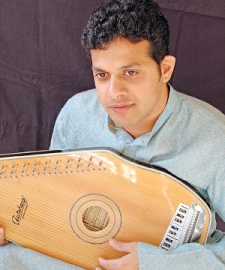
#TGLIFE: You are trained under Indian vocalist, composer and scholar of Indian classical, semi-classical and devotional music Pandit Jitendra Abhisheki, who hails from Mangueshi in Goa. Could you share some fond memories with him and Goa?
Mahesh Kale: Goa is close to my heart for two reasons - I first met Buva (Pandit Jitendra Abhisheki) here when I was 14 or 15 and secondly because this land is naturally beautiful. I remember Buva taking me to his ancestral home in Mangeshi where I wandered in his garden Buva was fond of his land. He used to be a different man whenever he was in Goa. He loved his mother tongue Konkani and I too learnt the basics of this language from him.
Your thoughts on the response of Goans to your music.
A frequent visitor to Goa, I have been invited to perform in various programmes here in the past too. I have conducted workshops during Bhajan and Kirtan Sammelans organised by Kala Academy. I believe that Goans are born music lovers. They respect music. During IFFI, after the release of Katyar Kalajat Ghusli, I rushed to Margao as I had an invitation to sing at Dindi Mahotsava. There I sang for the first time in a zatra. It was a late night programme where people were listening till 3.30 am with devotion. At Vasco Saptah too, it started raining when I was singing. Those who had umbrellas opened them but others stood patiently listening to the music. This devotion gives you a boost and you want to offer more than 100 per cent.
You performed solo when you were just three and mesmerised an audience of 5000 at Gondavale. Do you still have fond memories of this?
It was a programme of Kakad Aarti at Gondavale. It was my first public performance. I sang an abhang (devotional song) after which the public went crazy. They enjoyed my singing so much that everyone wanted to pamper me. Some gifted me one rupee coins while others stuffed me with sweet laddoos. The only thing I understood was that this was a win-win situation. I learnt that if I sing, I am pampered and showered with gifts. That was when I began to enjoy singing and delved into it more.
You are an engineer turned full-time singer. Why this U turn?
I was performing at a concert in Philadelphia and had just sung an abhang (devotional song) when an elderly Indian woman came to me and fell on my feet. She was so overwhelmed listening to the devotional song. She used to travel to Pandhari to the temple of Pandurang every year when she was in India. Now that she was abroad and a green card holder, she couldn’t do it too often. She exclaimed that my singing offered her ‘darshan’ of her Pandurang right her in Philadelphia. That was the moment when I decided if my music offers so much joy to people why not take it up as a full-time career. I left my job and devoted myself to music since then.
You have been teaching music to Indian and foreign students. Do you find some difference in their learning attitude? Or are there similarities?
I feel that one cannot discriminate or bifurcate, music lovers on the basis of their regions. Those who love music, devote their life to learning and promoting it, irrespective of the place where they belong. Indian atmosphere for music is very encouraging. The legacy of music seeps in the generations. If they wish, they can take it forward. But abroad, it is not so. People learn music there only if they have an inner compulsion for it. They have to inculcate the music, it doesn’t come naturally to them. But they work hard and are good students. Some of them drive for two-three hours to and fro, just for an hour-long workshop.
Why do Indian parents give more preference to academics over the arts?
Success in India often means a lot of money. If the children learn well, get good marks and are admitted in good educational institutes, parents feel that the road to success is open for them. One must understand that all parents love their children and wish that they become successful. But what is success? The focus should be on happiness and not material wealth. The parents must ask their children what gives them happiness and allow them to seek it and not wealth. If they are happy they will work towards success and wealth will follow.
Should music be in the DNA or genes for someone to learn it?
Musical inclination is inborn. All of us can be musicians, singers. The only thing is most of us don’t listen to our inner voice. If groomed, each one of us can be a singer.
The song Sur Niragas Ho that you sang in the National award winningMarathi film Katyar Kalajat Ghusli seems so difficult to sing.
It didn’t take me much time. The song had deeply touched my heart and once something like this happens, the song doesn’t need retakes. There is an instant connect.


